c. ? – 1962 CE
Kingdom of Rwanda
former kingdom in East Africa from the 15th century and up to 1962
Date range and summary are drafted from Wikidata pending a scholarly-source verification pass — treat as approximate, not settled fact, until re-sourced from academic historians/archaeologists.
Overview
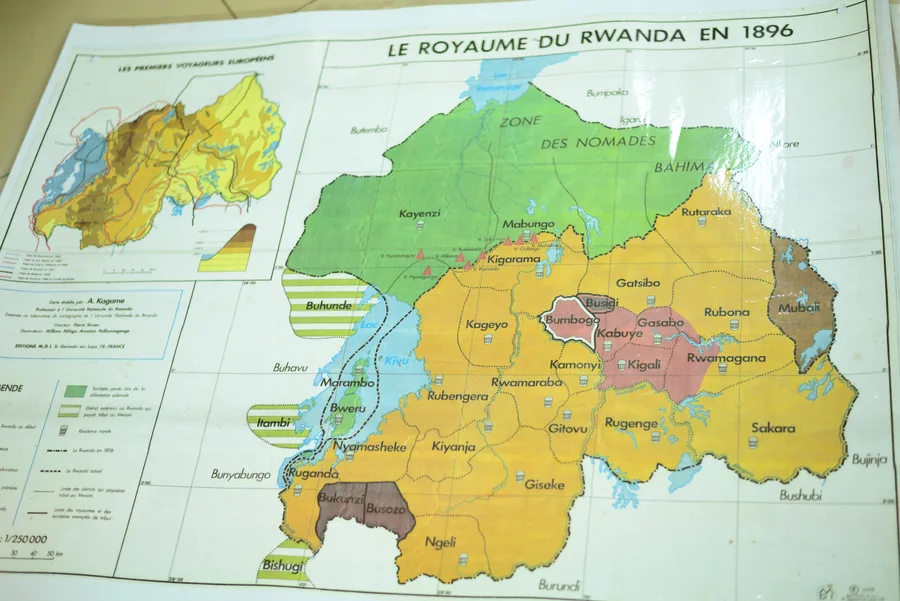
The Kingdom of Rwanda, also known as the Nyiginya Kingdom, was one of the most centralized states in precolonial Central and East Africa, built over centuries in the highlands of what is now Rwanda. Its territory was originally home to the Twa, who lived as hunters, gatherers, and potters; Hutu farmers migrated into the region beginning around 1000 CE and developed early centralized principalities; and, from the 15th to 16th centuries, waves of cattle-herding Tutsi migrated south and established chiefdoms whose warriors and attendants competed for land and influence, gradually consolidating into the kingdom that would dominate the region for centuries.
Governance and Consolidation
Rwanda’s precise founding date is unknown, preserved as it was in oral tradition rather than written record — tradition credits the legendary Gihanga, also said to have brought fire and cattle to the land, though historians generally regard him as a mythic founding figure rather than a documented historical ruler. What is well documented is the kingdom’s trajectory toward centralization: local lineage groups that had cleared and claimed land under a system called ubukonde gradually gave way to a unified, highly organized monarchy under a Tutsi royal line, producing one of the most administratively sophisticated states anywhere in the African Great Lakes region by the 19th century.
Kigeli IV Rwabugiri’s Expansionist State
The kingdom’s roots trace to the 14th–16th centuries, when a small chiefdom centered on the hill of Gasabo gradually expanded into a centralized state near Kigali; historians disagree on which ruler counts as its true founder, with some naming Ruganzu Bwimba and others Ruganzu II Ndoli, who is credited with subduing outlying Hutu communities in the 17th century. Rwanda’s most transformative ruler was Kigeli IV Rwabugiri, who between 1860 and 1895 redistributed land away from hereditary Hutu chiefs to Tutsi appointees, imposing a patronage system that left Hutu farmers laboring for Tutsi landlords in a serf-like arrangement — a documented, consequential social restructuring this site notes plainly given its later historical significance. Rwabugiri also introduced conscription and permanent military units, transforming Rwanda into a genuinely expansionist state that conquered numerous smaller kingdoms during his reign.
Colonial Rule and the End of the Monarchy
Rwanda’s kingdom retained a measure of internal autonomy even after German and then Belgian colonial administrations took formal control of the territory, an unusual degree of continuity compared to many colonized African states. That continuity ended abruptly in 1959, when the Rwandan Revolution erupted amid ethnic violence between Hutu and Tutsi communities; a 1961 referendum abolished the Tutsi monarchy and established a Hutu-dominated republic, and Rwanda gained full independence from Belgium in 1962. The deposed King Kigeli V went into exile in the United States, and a court-in-exile tradition continues among Rwandan monarchists today, with Yuhi VI currently recognized by them as pretender to a throne that once governed one of the most centralized kingdoms in African history.
Related
- Aksum Empire
- Kingdom of Benin
- Kingdom of Buganda
- Kingdom of Burundi
- Kingdom of Dahomey
- Ethiopian Empire (Solomonic Dynasty)
More in Politics