c. 1464 CE – 1591 CE
Songhai Empire
former state located in western Africa
Date range and summary are drafted from Wikidata pending a scholarly-source verification pass — treat as approximate, not settled fact, until re-sourced from academic historians/archaeologists.

Overview
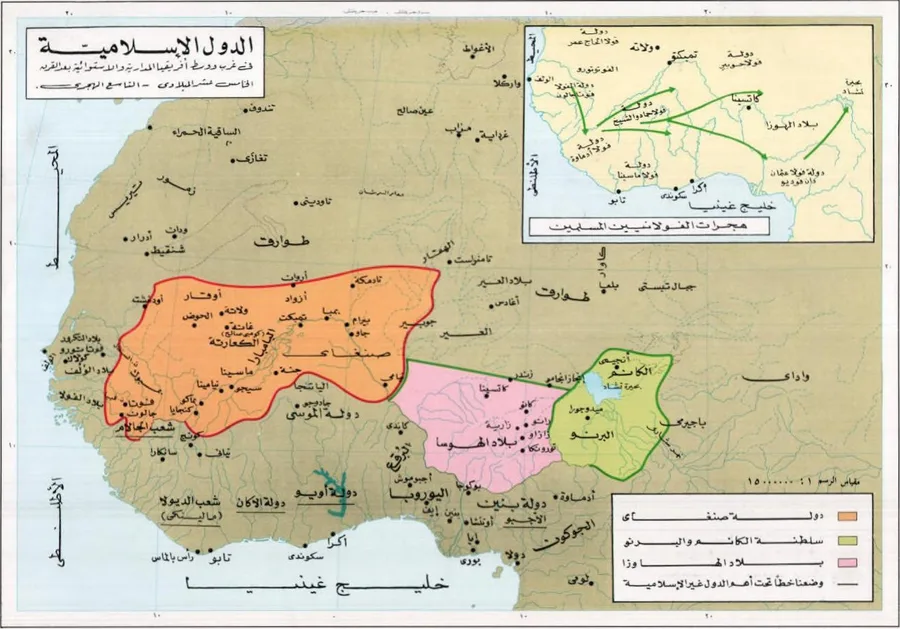
The Songhai Empire was the largest of West Africa’s great Sahelian empires, ruling much of the region through the 15th and 16th centuries from its capital at Gao, a city that had already been an important trading center since the 11th century. Songhai’s rise began as the Mali Empire, which had conquered Gao in the late 13th century, started to weaken in the 14th century, allowing the Songhai people to reassert control of their own city and then expand outward to fill the power vacuum Mali’s decline left behind.
Sonni Ali and the Conquest of Timbuktu
Under Sonni Ali, who founded the Sonni dynasty around 1464, Songhai surpassed Mali itself in area, wealth, and power, absorbing vast stretches of former Malian territory. Sonni Ali’s forces conquered the legendary trading and scholarly city of Timbuktu in 1468 and the commercial center of Djenné in 1475, giving Songhai control of the same trans-Saharan gold and salt trade networks that had made Ghana and Mali wealthy before it. These conquests made Songhai, for a time, the dominant economic and military power of the entire West African Sahel.
Askia the Great: Scholarship and Reform
Sonni Ali’s son and successor was overthrown by one of his father’s own generals, Muhammad Ture, who took the throne as Askia the Great and founded the Askia dynasty in 1493. Askia built a professional, full-time army rather than relying on the general levies earlier rulers had used, centralized the empire’s tax collection and courts into a real bureaucracy, standardized weights and measures, and had canals built to expand agriculture and trade. He also transformed Songhai into a major center of Islamic scholarship: after completing the hajj to Mecca with an escort reported at 500 cavalry and 1,000 infantry, Askia recruited Muslim scholars from Egypt and Morocco to teach at the Sankore Mosque in Timbuktu, turning the city into one of the most important centers of learning in the entire Islamic world, renowned for astronomy as well as religious and legal scholarship.
Decline and Legacy
Political stability frayed after Askia’s reign amid dynastic infighting and civil war among his successors, though the empire saw a further period of strength under Askia Daoud. Songhai’s collapse came from outside: in 1591, an invading Moroccan army under Judar Pasha, seeking control of the trans-Saharan trade routes, defeated Askia Ishaq II’s forces at the Battle of Tondibi, using firearms that Songhai’s own cavalry-and-iron-weapon army could not match. The empire’s political power ended there, but the scholarly reputation Askia the Great built at Timbuktu endured for generations afterward, and the written manuscript tradition it fostered remains one of the most celebrated legacies of any pre-colonial African state.